The Weary Christian
  • Depression
    • Depression

      Latest Medical Studies on Depression

      Depression

      James Bryan Smith: Unmet expectations and fear

      Depression

      STUDY: Criticizing older adults make them more vulnerable…

      Depression

      STUDY: Awe can reduce depressive symptoms

      Depression

      STUDY: How music-mindfulness can help depression, anxiety

  • Anxiety
    • Anxiety

      Calling out the brain on catastrophizing

      Anxiety

      James Bryan Smith: Unmet expectations and fear

      Anxiety

      STUDY: Awe can reduce depressive symptoms

      Anxiety

      STUDY: How music-mindfulness can help depression, anxiety

      Anxiety

      STUDY: Chronic pain associated with higher rates of…

  • Book quotes/Video
    • Book quotes/Video

      John Mark Comer: “Wherever Jesus went, the kingdom…

      Book quotes/Video

      Ann Voskamp: “Jesus saves you for Himself”

      Book quotes/Video

      Philippe: “Refusing to suffer means refusing to live”

      Book quotes/Video

      “In darkest night, you were there like no…

      Book quotes/Video

      Thanksgiving for his brokenness

  • Health News
    • Health News

      Latest Medical Studies on Depression

      Health News

      Calling out the brain on catastrophizing

      Health News

      STUDY: Mental health conditions share deep genetic patterns

      Health News

      STUDY: Four Supplements that MIGHT help depression

      Health News

      STUDY: Gut changes raise risk of eating disorders…

  • Interviews
    • Interviews

      INTERVIEW: Dr. Terry Powell’s gripping account of depression

      Interviews

      INTERVIEW: Therapist Michael Schiferl explains religious scrupulosity and…

      Interviews

      INTERVIEW: Rocker Matt Sassano shares battles, urges transparency…

      Interviews

      INTERVIEW: Dr. Brian Briscoe tells Christians that antidepressants…

      Interviews

      INTERVIEW: Pastor Scott Sauls on anxiety, depression, and…

  • Devotionals
    • Devotionals

      Think you’re a “failure?” Jesus sees you unlike…

      Devotionals

      “Grace has got to be drunk straight”

      Devotionals

      Defeated by God

      Devotionals

      Am I a faithless Christian?

      Devotionals

      “I killed Jesus of Nazareth”

  • About
  • Depression
    • Depression

      Latest Medical Studies on Depression

      Depression

      James Bryan Smith: Unmet expectations and fear

      Depression

      STUDY: Criticizing older adults make them more vulnerable…

      Depression

      STUDY: Awe can reduce depressive symptoms

      Depression

      STUDY: How music-mindfulness can help depression, anxiety

  • Anxiety
    • Anxiety

      Calling out the brain on catastrophizing

      Anxiety

      James Bryan Smith: Unmet expectations and fear

      Anxiety

      STUDY: Awe can reduce depressive symptoms

      Anxiety

      STUDY: How music-mindfulness can help depression, anxiety

      Anxiety

      STUDY: Chronic pain associated with higher rates of…

  • Book quotes/Video
    • Book quotes/Video

      John Mark Comer: “Wherever Jesus went, the kingdom…

      Book quotes/Video

      Ann Voskamp: “Jesus saves you for Himself”

      Book quotes/Video

      Philippe: “Refusing to suffer means refusing to live”

      Book quotes/Video

      “In darkest night, you were there like no…

      Book quotes/Video

      Thanksgiving for his brokenness

  • Health News
    • Health News

      Latest Medical Studies on Depression

      Health News

      Calling out the brain on catastrophizing

      Health News

      STUDY: Mental health conditions share deep genetic patterns

      Health News

      STUDY: Four Supplements that MIGHT help depression

      Health News

      STUDY: Gut changes raise risk of eating disorders…

  • Interviews
    • Interviews

      INTERVIEW: Dr. Terry Powell’s gripping account of depression

      Interviews

      INTERVIEW: Therapist Michael Schiferl explains religious scrupulosity and…

      Interviews

      INTERVIEW: Rocker Matt Sassano shares battles, urges transparency…

      Interviews

      INTERVIEW: Dr. Brian Briscoe tells Christians that antidepressants…

      Interviews

      INTERVIEW: Pastor Scott Sauls on anxiety, depression, and…

  • Devotionals
    • Devotionals

      Think you’re a “failure?” Jesus sees you unlike…

      Devotionals

      “Grace has got to be drunk straight”

      Devotionals

      Defeated by God

      Devotionals

      Am I a faithless Christian?

      Devotionals

      “I killed Jesus of Nazareth”

  • About

The Weary Christian

THE WEARY CHRISTIAN

LIVING WITH FAITH AND DEPRESSION

  • Depression
    • Depression

      Latest Medical Studies on Depression

      Depression

      James Bryan Smith: Unmet expectations and fear

      Depression

      STUDY: Criticizing older adults make them more vulnerable…

      Depression

      STUDY: Awe can reduce depressive symptoms

      Depression

      STUDY: How music-mindfulness can help depression, anxiety

  • Anxiety
    • Anxiety

      Calling out the brain on catastrophizing

      Anxiety

      James Bryan Smith: Unmet expectations and fear

      Anxiety

      STUDY: Awe can reduce depressive symptoms

      Anxiety

      STUDY: How music-mindfulness can help depression, anxiety

      Anxiety

      STUDY: Chronic pain associated with higher rates of…

  • Book quotes/Video
    • Book quotes/Video

      John Mark Comer: “Wherever Jesus went, the kingdom…

      Book quotes/Video

      Ann Voskamp: “Jesus saves you for Himself”

      Book quotes/Video

      Philippe: “Refusing to suffer means refusing to live”

      Book quotes/Video

      “In darkest night, you were there like no…

      Book quotes/Video

      Thanksgiving for his brokenness

  • Health News
    • Health News

      Latest Medical Studies on Depression

      Health News

      Calling out the brain on catastrophizing

      Health News

      STUDY: Mental health conditions share deep genetic patterns

      Health News

      STUDY: Four Supplements that MIGHT help depression

      Health News

      STUDY: Gut changes raise risk of eating disorders…

  • Interviews
    • Interviews

      INTERVIEW: Dr. Terry Powell’s gripping account of depression

      Interviews

      INTERVIEW: Therapist Michael Schiferl explains religious scrupulosity and…

      Interviews

      INTERVIEW: Rocker Matt Sassano shares battles, urges transparency…

      Interviews

      INTERVIEW: Dr. Brian Briscoe tells Christians that antidepressants…

      Interviews

      INTERVIEW: Pastor Scott Sauls on anxiety, depression, and…

  • Devotionals
    • Devotionals

      Think you’re a “failure?” Jesus sees you unlike…

      Devotionals

      “Grace has got to be drunk straight”

      Devotionals

      Defeated by God

      Devotionals

      Am I a faithless Christian?

      Devotionals

      “I killed Jesus of Nazareth”

  • About
DepressionHealth News

Latest Medical Studies on Depression

STUDY: Mental health conditions share deep genetic patterns

James Bryan Smith: Unmet expectations and fear

STUDY: Four Supplements that MIGHT help depression

STUDY: Criticizing older adults make them more vulnerable to developing depression

Daily Blog

OCD: Can you learn to love uncertainty? (It’s hard, but might really help. Has helped me sometimes)

OCD: Can you learn to love uncertainty? (It’s hard, but might really help. Has helped me sometimes)

written by Christian Heinze

Obsessive compulsive disorder (OCD) is marked by obsessive thoughts that repeat, over and over — against the individual’s wishes — and are only relieved by a compulsive behavior.

The really nasty part is that the fear is only temporarily relieved by the compulsive behavior. You feel better for a second, but in fact, you’ve just reinforced the problem by doing the compulsive thing and getting brief comfort from it.

I’ve had OCD, in some form or another, for decades.

My obsessions have changed, some have increased my productivity, others have practically debilitated me, and the only consistency is that the obsessions lead to a place where the one thing you want to get away from — your mind — is the only thing you can’t escape.

Soon after my dad passed away, I was sitting at my desk, working, and my 1 year old son came crawling around the corner, smiling, right up to my desk.

He knew exactly where I was, and that’s why he was smiling, and he knew that I would put him in my lap, and that’s why he crawled to my desk.

Suddenly, the thought hit me — what if I died, and my son came crawling around the corner, looking for me, and I wasn’t in my chair? He wouldn’t understand anything except not seeing me. And he would crawl through the whole house and I wouldn’t be behind any corner.

That morbid thought fueled about 6 months of obsession over my health and the idea that I might die on my son. I wrote him birthday letters for every year that I would be dead, so that he would never have to go a birthday without his dad.

I googled every possible health issue, I have about 300 bookmarks from WebMd, the Mayo Clinic, Healthline, Drugs.com, and every discussion board out there. And that’s not including my cell phone home screen. I couldn’t even find my camera icon for awhile.

“Nothing else really matters,” I thought, “except staying alive for my son, so he always has a chair to crawl to.”

The obsession was staying alive for my son, the compulsion was googling or writing my son “letters from my grave.” I felt better for a few seconds, then terrible again, and had to write to make things momentarily better.

I was miserable. And both rational and irrational. Nearly everyone with OCD knows, at some point or another, that their obsessions are irrational. But the more you want out, the more you get pulled in.

It’s like saying, “I will not think about polar bears, I will not think about polar bears.” Well, what are you thinking of?

In fact, one of the truest principles is that the more someone with OCD fixates on “fixing” their obsession, the stronger the obsession becomes.

That’s why hours of earnest prayer about your obsession itself can be dicey. “Lord, please help me not think about polar bears! Please, please, take my mind off polar bears!” Pray that for two hours, and you’ll still be in the Arctic Circle.

Now I want to talk about a spiritual aspect to OCD, but first, it’s important to bring up a few scientific studies, because they complement that perspective.


Stanford University notes that we’re getting clearer evidence that OCD is a biological disease, and functional brain imaging studies are giving us a much clearer picture of what goes on in the OCD brain.

“It is thought that in people with OCD, the basal ganglia is unable to filter the messages and sends out wrong signals to the thalamus located at the top of the brain stem. When the thalamus receives a wrong signal, it becomes hyperactive and sends back strong signals to the prefrontal cortex via the loop.

The prefrontal cortex reacts to these signals by increasing compulsive behavior and anxiety.”

And indeed, results of neurosurgical treatment support that idea.

“Surgical interruption of this loop by means of cingulotomy, anterior capsulotomy or subcaudate tractotomy brings about symptomatic improvement in a large proportion of patients unresponsive to all other treatments.”

So that’s the neuroanatomy.

Then there’s a neurochemistry component, with improper seratonin levels being one of the likely culprits. In fact, the efficacy of SSRI’s in many cases of OCD suggests just such a mechanism.

A recent, fascinating study comes from the University of Cambridge, which shows just how poorly brains with OCD adapt to, well, reality. Particularly, when it comes to fear.

People with and without OCD were shown two angry faces. One face was associated with an electric shock, while the other wasn’t. Both groups responded with appropriate fear to the face associated with the electric shock.

Then, the investigators reversed the stimuli. They linked up the electric shock to the “safe face”, and withdrew it from the “unsafe face.” Healthy people’s brains were able to re-learn and adjust to what was unsafe. And they now correctly judged which face was safe. On the other hand, those with OCD were unable to distinguish between the safe and unsafe.

Instead, they now saw both faces as unsafe.

Why?

“Unlike in healthy participants, there was no signal from the OCD patients’ ventromedial prefrontal cortex, a brain area that normally signals safety.”

So you can see the problem. Someone with OCD has trouble appropriately adjusting their sense of fear based on new information.

Instead, the thing that was fearful and has now been proven safe — well, it remains scary.

And this fear isn’t a choice. It’s an inability for the brain to adjust to new information about threats.

The authors conclude:

“An avenue for improving future treatment for OCD would be to explore better learning in patients that not performing compulsive safety behaviours is truly safe. This could be achieved by boosting rewards in therapy for not performing safety behaviour or possibly with the help of certain drugs that can enhance the positive experience of not having to perform the compulsions.”


Now in the face of all this, doctors have given me this message — an irrational sense of fear will always accompany my obsession du jour (or for me, obsession du mois).

My brain will probably have it no way otherwise.

For many of us, uncertainty is the fundamental tributary into our obsessions and, ultimately, our fears.

That’s why some measure of certainty from our compulsion relieves us, but never changes us.

OCD is closely-related to anxiety, because anxiety is about uncertainty, as well.

Think about the things that make you anxious. Isn’t there some measure of uncertainty involved in every single one?

So what do we do about uncertainty? We could think about God’s sovereignty, but in a way, that’s about trying to squelch uncertainty, and for a brain with OCD “trying to squelch” will lead to “magnifying massively.”

Instead of trying to squelch uncertainty, it’s best to learn how to live with it.

I was reading John 6 a few weeks ago, and something struck me.

Christ’s miracles in the Gospels often involve an instantaneous reduction of uncertainty.

For example, a blind man is begging for mercy, and Jesus turns around and heals him (Luke 18). A woman touches Christ’s clothes and she’s immediately healed (Luke 8).

But there’s another miracle that demanded much more of the beneficiaries.

In John 6, when the disciples are in their boat, and the storm gets all stormy, Jesus comes, walking on water, and what doesn’t he do? He doesn’t immediately calm the storm. Instead of giving instant relief, he asks the disciples to live with uncertainty a bit longer.

Why?

Of course, it’s perilous to read into the Son of God’s mind, but I wonder if it’s because of a consistent theme in the Bible – that the closer we get to Him, the more he demands of our faith. The disciples were far closer to the Lord than the lame or blind, they had seen his miracles, they knew him better.

So here’s my big question for you – have you ever thought that maybe the Lord is asking you to live with uncertainty for a longer time because of your deep friendship with him?

That instead of it being a sign that he’s abandoned you, that you’re actually quite close?

That’s not the way I instinctively view the cross of uncertainty.

When God doesn’t resolve my uncertainty, I implicitly take it as a sign that he’s distanced himself from me. And so do many who suffer.

But in reality, it could be the opposite. Uncertainty might mean you’re closer to him than ever.

That’s a hopeful thought — that this uncertainty could be a sign of friendship, not distance. But if you’re like me, it’s also a troubling one, because a pessimist might answer, “Well, if I get closer and closer to him, won’t he just wait longer and longer to calm the storm?”

Good luck, you can torture yourself with that. It’s a close cousin to, “If God grows my faith through trials, what’s next for me after that car just hit me?”

Who knows. It’s uncertainty. Maybe God will grow your faith by letting a bus run over you next time. Or maybe you’ll win the lottery, and he’ll use something about that to grow your faith.

Here is the important thing: you can never beat uncertainty, and the only way to live with it is to trust the mind of God, not try to read it.

Now one more verse about those of us who try to fight and subdue uncertainty any way that we can.

When Judas and his cronies come to arrest Jesus in John 18, Peter pulls out a sword and cuts off an ear. But Jesus tells him.

“Put your sword back into its sheath. Shall I not drink from the cup of suffering the Father has given me?”

In the face of our OCD and anxieties, you and I pull out swords all the time to try to fight the uncertainty. But just like Peter, we need to realize who is standing by us as we pull out the sword. Jesus, God Almighty. We aren’t pulling out our swords in the absence of God, we are doing it in his presence.

Our swords are illusions of power, yes, but as importantly, they are delusions about his purpose.

For someone with OCD, thinking about purpose is more meaningful than power. If we think about power, we’re likely to say, “Why won’t God make this better — he’s powerful enough!” But if we think about purpose, then uncertainty enters the picture, and we need to make peace with that.

And in the case of Peter’s ear cutting, and Christ’s arrest, this is much more about purpose than power.

The next part of the “Put your sword back into its sheath” proves it:

“Shall I not drink from the cup of suffering the Father has given me?”

This completes the OCD and anxiety picture. Our swords aren’t just impotent, they also might run counter to what God has planned. And, in Christ’s case, and maybe in ours, it might be actually experiencing the suffering that our anxiety or obsession is based on.

When you say, “Shall I not drink from the cup of suffering,” you don’t just put down your sword, it falls miraculously. You don’t need to come up with a thousand ways to fend off your anxieties because fending them off isn’t important anymore.

So this is all I can say.

First, like the disciples in the boat, if Christ is asking you to walk through uncertainty right now, try to think of it as a reflection of his friendship, not his abandonment.

Second, as you think about that uncertainty, don’t pull out a sword.

Whatever trials lie ahead of you, Jesus also lies ahead of you.

So I say this to myself, and to my friend Jesus, who is both walking toward me in the storm and beside me in the dark garden.

“Shall I not drink from the cup of suffering the Father has given me?”

If so, I will be drinking with him.


Disclaimer: If you have or suspect you might have OCD, see a mental health professional.

CBT and medication can be very helpful. God gives us these things to help. Facing cancer can be easier with devotionals, but devotionals don’t fix it. The same applies to mental illness.

Picture: It’s called “Dazzle Camouflage.”

Good resource for OCD here.


May 17, 2018
0 Facebook Twitter Google + Pinterest
!!

!!

written by Christian Heinze

One of my favorite quotes from Brennan Manning:

“God wants us back even more than we could possibly want to be back.”

May 16, 2018
0 Facebook Twitter Google + Pinterest

Affluent black youth more likely to suffer from depression

written by Christian Heinze

A new study suggests that more affluent black youth are more likely to suffer from depression than white youth from similar socioeconomic status (SES).

Michigan Daily:

“The higher rates of depression among Black youth, according to Assari, could be a response to many societal situations. One situation, Assari proposed, could be wealthy Black families living in predominantly white neighborhoods, which could lead to higher rates of discrimination and depression.

He also suggested the distance these Black families have from other Black communities could result in a lack of an emotional support group and mental health resources. However, Assari maintained more research must be done in this field to explore the dominant reasons for why these high depression rates occur in Black high-SES populations.”

The Root points out another fact which supports the hypothesis — whites with a lower SES tend to be much less resilient than blacks with lower SES; whereas, blacks with higher SES struggle with stress and depression more than whites in a higher SES.

That certainly does suggest there’s a role for isolation in all this.

Another theory:

“….the high rates of stress among affluent blacks could be the result of a coping mechanism called “goal-striving stress.” Often prevalent in black achievers, it is the stress and disappointment experienced when achievements don’t match one’s aspirations. The glass ceilings encountered by black populations often lead to poor mental health.”

May 16, 2018
0 Facebook Twitter Google + Pinterest
Why don’t church leaders talk about their own mental illness?

Why don’t church leaders talk about their own mental illness?

written by Christian Heinze

One of the most disappointing statistics in Amy Simpson’s book, Troubled Minds: Mental Illness and the Church’s Mission is that 50% of pastors only mention mental illness one to three times per years in their sermons, while 20% don’t even mention it, at all.

You might think simple ignorance is behind that, but as Simpson notes herself, nearly 40% of church leaders have acknowledged suffering from some type of mood disorder such as depression or bipolar, while 23% say they’ve suffered from an anxiety disorder.

In our discussion, I asked her why a great number of pastors — who clearly struggle with this issue — won’t speak up. After all, that would be one of the most effective gestures possible to reduce stigma and open up genuine conversation in the church.

Her answer:

“When you experience a mood disorder, that disorder lies to you all the time. It tells you things that are not true about yourself, about God. And I think pastors can be as susceptible to that as anyone else. And they may actually believe, “You know it’s because my faith isn’t strong enough” or “It’s because God has walked away from me.”

At the same time, there are a lot of church leaders out there who are afraid that if they mention anything about their own struggle with mental health, they will lose their jobs.  They feel a lot of pressure to live up to the expectations – whether real or perceived – of people in their congregation, so they keep quiet.

That’s one of the great tragedies – that when people are in crisis, when they most need people, when we most need to reach out to one another, is when stigma raises its head and keeps us quiet.

So I think that’s sometimes what we’re looking at with people in ministry. Their own stigma, their own fear actually keeps them silent and deepens that sense of stigma, not only for themselves, but also for their congregation.”

May 16, 2018
0 Facebook Twitter Google + Pinterest
The future? A beam of light for your anxiety?

The future? A beam of light for your anxiety?

written by Christian Heinze

A new study of mice has found “anxiety cells” in the hippocampus.

“We call these anxiety cells because they only fire when the animals are in places that are innately frightening to them,” explains senior researcher Rene Hen from Columbia University.


The output of these cells was traced to the hypothalamus, a region of the brain that – among other things – regulates the hormones that controls emotions.”

Now the amazing part. Using optogenetics, the scientists targeted the anxiety cells with a beam of light, leading to “confident, anxiety-free activity in the mice.”

They explored more, demonstrated less fear.

The big takeaway:

“…the next steps will be to find out whether the same control switch is what regulates human anxiety – and based on what we know about the brain similarities with mice, it seems plausible.


If that pans out, these results could open a big new research lead into ways to treat various anxiety conditions.”

Stuff like this is very exciting. I just hope I live long enough for this kind of technology to hit humans, but if I don’t, I’ll be in heaven, which will also be an effective treatment for anxiety.

(Fun fact unrelated to mice and anxiety, but related to the picture): Gustave Eiffel built a secret apartment for himself at the top of the Eiffel Tower. But he never let anyone but himself stay there.

Photo: Pexels.
May 14, 2018
0 Facebook Twitter Google + Pinterest
The most depressed states in the country

The most depressed states in the country

written by Christian Heinze

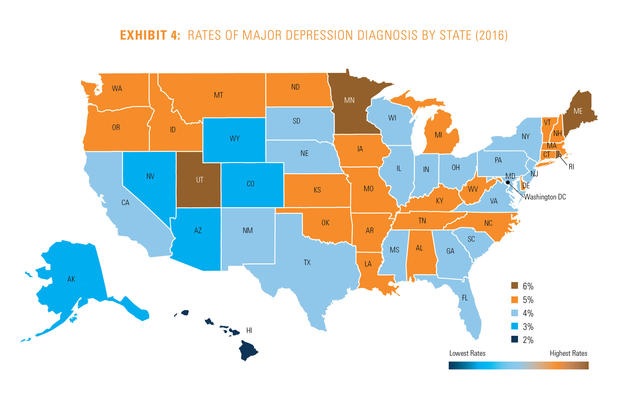
A new study by Blue Cross/Blue Shield shows Rhode Island scoring highest on depression; Hawaii lowest. Look at that map.

Sunlight.

Of course that passes the smell test — and for good reason.

“One Australian study that measured levels of brain chemicals flowing directly out of the brain found that people had higher serotonin levels on bright sunny days than on cloudy ones.”

Now the super interesting part.

“That effect remained no matter how cold or hot the weather was.”

So in other words, sun is the key; not warmth.

May 14, 2018
0 Facebook Twitter Google + Pinterest

Latest Mental Health News and Tips

written by Christian Heinze

via GIPHY

DEPRESSION:

A new study in JAMA Psychiatry finds strength training (resistance exercise) associated with a significant reduction in depressive symptoms.

Time Mag:

“Research suggests that by increasing blood flow to the brain, exercise can change the structure and function of the brain, create new brain cells and trigger the release of mood-enhancing chemicals like endorphins.”

By the way — personal note. The time to do this is when you’re feeling 0-6 on the depressive scale. Once you’re a 7 or above, lifting the toilet paper roll is the most resistance training you can do. So, as with other tips, being proactive is vital. Once you’re in despair, it can feel impossible to say “Ah! Weights today! Gonna feel better! Let’s do this!”

ANXIETY:

A. 40% of Americans feel more anxious today than they did a year ago. They report feeling more anxious about health, finances, safety, politics, and relationships.

Health and Safety were the Big Two, with 68% of Americans saying they felt extremely or somewhat anxious about both health and safety.

B. Fascinating article: Here are 15 signs that you’re an introvert with “High-Functioning Anxiety.”  Included: you constantly feel the need to do something, you’re outwardly successful, you’re a perfectionist, you’re afraid of disappointing others. Psych Today points out the anxiety-based foundation for the 15 signs.

C. In Inc Mag., Author Sarah Wilson says Anxiety is an incredibly common trait among entrepreneurs.

“An obsession with the future, which sufferers fear, also predisposes the anxious for startup life. Entrepreneurs ‘are constantly over-attending to things that might happen’,” Wilson says. “They see what is ahead’.”

Wilson then offers entrepreneurs tips on dealing with it.

ANOTHER CREATIVITY/MENTAL ILLNESS STUDY:

A new study in the British Journal of Psychiatry finds that those students in Sweden pursuing artistic degrees such as acting and writing were much more likely to eventually be diagnosed or hospitalized with schizophrenia, bipolar, or unipolar depression.

Specifically, students who pursued such degrees were 90% more likely to be hospitalized with schizophrenia later in life, 62% more likely to be hospitalized for bipolar, and 39% more likely to be hospitalized for depression.

IFL Science looks at this and other studies on creativity and mental health…

“So why does this connection exist?


Well, it’s still not really clear. It could be that creative people are more likely to think deeply and be emotionally unstable, making them more vulnerable to conditions like depression.


Meanwhile, bouts of productivity and high energy are linked to both creativity and bipolar disorder. Lead author James McCabe told New Scientist that the genetics behind creativity might also influence mental health.


“Creativity often involves linking ideas or concepts in ways that other people wouldn’t think of,” he told New Scientist. “But that’s similar to how delusions work – for example, seeing a connection between the color of someone’s clothes and being part of an MI5 conspiracy.”

Big note about this study. This is NOT a causation study. In other words, in no way does it suggest — at all — that the pursuit of those degrees makes you more likely to develop these conditions. Instead, if there’s a relationship, it’s likely correlation. In other words, people who are depressed or have mental illness are more likely to be drawn to certain disciplines.

VERSE of the DAY:

Luke 1:78

Because of God’s tender mercy

The morning light from heaven is about to break upon us,

to give light to those who sit in darkness

and in the shadow of death

and to guide us to the path of peace.

May 10, 2018
0 Facebook Twitter Google + Pinterest
How major depression affects fertility in some men

How major depression affects fertility in some men

written by Christian Heinze

A new study from the NIH shows that, among those couples being treated for infertility, men with major depression were 60% less likely to conceive with their partner.

The interesting thing? Women with major depression were no more or less likely to conceive.

However, women who used a type of antidepressant called non-SSRI’s (as opposed to the popular SSRI’s) were 3.5 times more likely to have a first trimester pregnancy loss.

The key thing to note is that this study looks at couples who are specifically being treated for infertility.

However, elsewhere, studies have shown that stress can affect male fertility, even in those not being treated for infertility.

Men who experienced two or more stressful life events in the past year had a lower percentage of sperm motility and a lower percentage of sperm of normal morphology, compared with men who did not experience any stressful life events.

Guys, it’s important for you to get help with stress.

So many men reel at the idea, because of cultural perceptions that men are supposed to be beacons of strength.

Well, yes, be strong and admit you’re weak, and get help.

The fact of the matter is that men have lower rates of anxiety and depression mainly because they’re much less likely to seek help for it than women. Thus, it’s likely underrreported. And that’s probably not because of a lower rate. 28% of men say they refuse to seek help for their anxiety, while only 19% of women say the same.

But that pride is dangerous.

“Men may be more likely to suffer in silence or try to self-medicate with alcohol or drugs,” says Dean F. MacKinnon, MD, an associate professor of psychiatry and behavioral sciences at the Johns Hopkins School of Medicine in Baltimore.


Men may see their symptoms as a sign of weakness, he explains, likening the situation to the idea that men don’t like asking for directions.

May 8, 2018
0 Facebook Twitter Google + Pinterest
Important stats on mental illness in the church

Important stats on mental illness in the church

written by Christian Heinze

There isn’t a ton of empirical data on mental illness and the Protestant church, but there are two important studies you should know about as a starting point. There is both encouraging and discouraging news in both.

One of the most discouraging results is that 76% of pastors and 74% of family members believe a Christian with mental illness can “thrive spiritually, even if their condition is not stable.”

I have no idea how someone who’s drenched in depression, anxiety, or even more significantly, a psychotic disorder, can “thrive spiritually.”

Yes, they can (except for in the case of a severe psychosis) obey Christ, but is rote obedience “thriving spiritually?”

That result says three things.

One, churches still aren’t getting the link between the physical disorder and spiritual walk.

Two, there’s still widespread ignorance about how mental illness affects the body.

Three, the age-old template of shaming is still in place. If someone can “thrive spiritually,” even while their mental condition is unstable, then of course the church won’t show much compassion to the mentally ill.

In this poll result, I suspect there might be a “with God, all things are possible” dynamic at work, where Christians are loathe to say that anything can prevent anyone from thriving spiritually. Yes, with God, all things are possible, but that does not mean all things are probable.

And it is very probable that an unstable mental illness that keeps the Christian from thriving in every other aspect of their life will keep them from thriving in their spiritual walk.

Perhaps this is why 18% say they’ve left a church because of the congregation’s response to their mental health.

One more thing — if you notice I italicized unstable. I don’t like that word, because it implies the individual is a few bad days away from doing something horrible. A better word for that is untreated.

So…yes, it’s completely possible for a Christian with a treated mental illness to thrive spiritually. The church and world is full of people who thrive despite mental disorders. However, it becomes much more difficult for anyone to thrive — in any capacity — with a disorder that is untreated.

Each of the statistics below is probably worthy of its own post, but here’s a laundry list.

These are highlights from Amy Simpson’s extensive survey on mental illness, published in her book on mental illness in the church.

-Only 12.5% of church leaders say mental illness is discussed openly and in a healthy way in their church.

-37% of leaders say someone in church has suffered from a psychotic disorder.

-38.7% of church leaders indicated they had suffered from a mood disorder such as depression or bipolar disorder. These say they feel more equipped to help congregants who are going through the same thing.

-23% of church leaders say they’ve suffered from an anxiety disorder.

-9% of church leaders say they’ve suffered from impulse control and addiction disorders.

-77% of church leaders are approached more than 2x/year for help with mental illness.

-37..9% of church leaders have never reached out to someone in their congregation with mental illness, despite being aware of it.

-30.5% of survey respondents said “mental illness is a reflection of a spiritual problem that must be treated spiritually.”

-29.4% of survey respondents said mental illness is a “behavioral problem caused by a person’s bad choices.

-19.7% said it’s “indicative of demon possession/demonic influence.”

-53.2% of survey respondents say they feel “somewhat equipped” to minister to people with mental illness, 16.1% feel “not equipped at all.”

Another big study comes from LifeWay Research study from 2014 (see pdf here).

-49% of senior Protestant pastors say they “rarely” or ‘never” speak about mental illness in their sermons. 16% say they do once per year. However 60% of those with mental illness in the church want the church to talk openly about it, and 65% of their families do, as well.

-Most pastors (76%) and family members (74%) think Christians with mental illness can “thrive spiritually, even if their condition is not stable.” Only 24% say they don’t know or disagree. Unbelievable.

-79% of those with mental illness had received therapy, and said it was effective.

-This survey has more hopeful results for medication than we’ve seen in the past — 87% of pastors and 54% of those with mental illness say medications should be used, when appropriate.

-18% of mentally ill people have broken ties with a church due to the response from the church; 53% say their church has been supportive.

-Only 56% of pastors “strongly agree” that “local churches have a responsibility to provide resources and support to individuals with mental illness and their families.”

 

May 7, 2018
0 Facebook Twitter Google + Pinterest
Spurgeon’s greatest hits on depression, anxiety, and panic

Spurgeon’s greatest hits on depression, anxiety, and panic

written by Christian Heinze

The great 19th century Baptist preacher Charles Spurgeon is a tough case for the “mental illness is spiritual” camp.

Many in the “mental illness is spiritual” camp are suspicious of contemporary preachers and theologians. But Spurgeon is rightly considered a giant of the faith by this group.

His mental illness presents a dilemma. If you say depression, anxiety and panic are either sins or reflective of a spiritual problem, the greatest preacher in evangelicalism’s history shouldn’t have been near a pulpit.

Because he was often overwhelmed with depression, anxiety and panic.

So did Spurgeon’s anxiety reflect insufficient faith in the promises of Christ, did his fear betray a lack of trust in God, and did his depression mean a Spirit of God that “always produces joy” was missing from his soul?

Further, are critics prepared to argue that Spurgeon could have just spent more time in prayer, studying Scripture, and at church to fight off his mental illness? Because that’s what the “mental illness is spiritual” camp tells the rest of us Christians.

Would they tell that to Spurgeon?

I’d like to highlight a few of Spurgeon’s quotes on these issues.

All are taken from Zack Eswine’s stellar “Spurgeon’s Sorrows” book, which is a deep dive into his sermons and writings, as well as Michael Reeve’s discussion of Spurgeon’s depression.


DEPRESSION AND ANXIETY AS MEDICAL PROBLEMS; NOT SINS

Spurgeon, in a sermon called “The Fear of Death”, and another called “Night and Jesus Not There.”

“There are certain forms of disease which so affect the brain and whole nervous system that depression is a melancholy symptom of the disease.”

And…

“I would not blame all those who are much given to fear, for in some it is rather their disease than their sin, and more their misfortune than their fault.”

It blows me away that the greatest evangelical preacher of the 19th century calls fear a disease and not a sin, that it is “misfortune” more than “fault.” I’m not even sure how often you’d hear that in modern evangelical churches.


THE SUDDEN, INEXPLICABLE ONSET OF MENTAL ILLNESS

From “The Saddest Cry of the Cross.”

“Quite involuntarily, unhappiness of mind, depression of spirit, and sorrow of heart will come upon you. You may be without any real reason for grief, and yet may become among the most unhappy of men.”

And “Night and Jesus not there.”

“There is a kind of mental darkness, in which you are disturbed, perplexed, worried, troubled – not, perhaps, about anything tangible.”

Note that he’s not talking about a causal or triggering event. Depression, anxiety, panic often just hit you – for no discernible reason. Interestingly enough, one of the distinguishing characteristics of a panic disorder is when you can’t find an easily identifiable trigger for the panic attack.


THE FOLLY OF JUDGING THOSE WITH MENTAL HEALTH PROBLEMS

Spurgeon, in “Man unknown to Man.”

“Especially judge not the sons and daughters of sorrow. Allow no ungenerous suspicions of the afflicted, the poor, and the despondent.

Do not hastily say they ought to be more brave, and exhibit a greater faith. Ask not ‘why are they so nervous and so absurdly fearful?’ No… I beseech you, remember that you understand not your fellow man.”

And from “The Saddest Cry from the Cross.”

“Strong-minded people are very apt to be hard upon nervous folk and to speak harshly to people who are very depressed in spirit, saying ‘really, you ought to rouse yourself out of that state’.”

Pride is a great sin, and spiritual pride is the greatest. Remember the Pharisee who prayed in Luke 18:11, “God, I thank you that I am not like other men, extortioners, unjust, adulterers, or even like this tax collector”.

Jesus didn’t say he was lying, but he also didn’t praise him for righteousness. He instead condemned him for arrogance. His pride wiped away everything else.

When you begin to understand the biological basis for mental illness, you have no room for spiritual pride.

Good health is a gift, faith is a gift, joy is a gift, good mental health is a gift, confidence in God’s promises is a gift. “Every good and perfect gift is from above.” (James 1:17). Who can brag about getting gifts?


SPURGEON’S DEPRESSION AND SUICIDAL THOUGHTS

Spurgeon, in “Israel’s God and God’s Israel.”

“I suppose that some brethren neither have much elevation or depression. I could almost wish to share their peaceful life. For I am much tossed up and down, and although my joy is greater than the most of men, my depression of spirit is such as few can have an idea of.”

And nearly suicidal.

“I could say with Job, ‘My soul chooseth strangling rather than life’ [Job 7:15]. I could readily enough have laid violent hands upon myself, to escape from my misery of spirit.”

And surprised that more aren’t in “Chastisement.”

“I wonder every day that there are not more suicides, considering the troubles of this life.”

Of course, as all Christians should, Spurgeon turned to Christ during his miseries, and sometimes he felt relief, sometimes he did not.

Here is one of his prayers from his autobiography.

“Thou art my Father, and I am Thy child, and thou as a father, art tender and full of mercy. I could not bear to see my child suffer as Thou makest me suffer; and if I saw him tormented as I am now, I would do what I could to help him, and put my arms under him to sustain him. Wilt thou hide thy face from me, my father? Wilt thou still lay on me thy heavy hand, and not give me a smile from thy countenance?”

So to finish — are we prepared to say that Spurgeon didn’t pray, study the Bible, or seek God enough? Are we prepared to say that the Lord often “withheld joy because Spurgeon wasn’t following Christ?” Because if we tell that to Christians struggling today, you’d have to tell that to Spurgeon, as well.

May 7, 2018
7 Facebook Twitter Google + Pinterest
Load More Posts

Social Media

Twitter

Get in touch with me

Contact here. 

The Weary Christian mission:

First off:


In the United States, find a psychiatrist here.

In the United States, find a therapist here.

If you’re in the United States and having thoughts of harming yourself or others, please call the National Suicide Lifeline at 1-800-273-8255.

If you’re in the UK, get urgent help here.

Canada, here.

Australia, here.

New Zealand, here.

South Africa, here.

France, here.

Germany, here.

Portugal, here.

Mexico, here.

India, here.

The Philippines, here.

Singapore, here.

South Korea, here.


The Weary Christian goal…


a) reduce the stigma surrounding depression, anxiety, OCD, and other conditions in the Christian community.


b) have uncomfortable but honest conversations.


c) Reduce the stigma surrounding antidepressants, antipsychotics, and other meds God has given us as gifts.


And…


d) Sometimes (tons of times), we all feel really, really depressed in our journey. Hopefully, this site makes you feel less alone.

Categories


@2017 - PenciDesign. All Right Reserved. Designed and Developed by PenciDesign