

The Weary Christian
  • Depression
    • Depression

      James Bryan Smith: Unmet expectations and fear

      Depression

      STUDY: Criticizing older adults make them more vulnerable…

      Depression

      STUDY: Awe can reduce depressive symptoms

      Depression

      STUDY: How music-mindfulness can help depression, anxiety

      Depression

      STUDY: Chronic pain associated with higher rates of…

  • Anxiety
    • Anxiety

      Calling out the brain on catastrophizing

      Anxiety

      James Bryan Smith: Unmet expectations and fear

      Anxiety

      STUDY: Awe can reduce depressive symptoms

      Anxiety

      STUDY: How music-mindfulness can help depression, anxiety

      Anxiety

      STUDY: Chronic pain associated with higher rates of…

  • Book quotes/Video
    • Book quotes/Video

      “In darkest night, you were there like no…

      Book quotes/Video

      Thanksgiving for his brokenness

      Book quotes/Video

      Esther Smith: “All he wants is you”

      Book quotes/Video

      James Bryan Smith: Unmet expectations and fear

      Book quotes/Video

      Staton: On being a witness

  • Health News
    • Health News

      Calling out the brain on catastrophizing

      Health News

      STUDY: Mental health conditions share deep genetic patterns

      Health News

      STUDY: Four Supplements that MIGHT help depression

      Health News

      STUDY: Gut changes raise risk of eating disorders…

      Health News

      STUDY: Criticizing older adults make them more vulnerable…

  • Interviews
    • Interviews

      INTERVIEW: Dr. Terry Powell’s gripping account of depression

      Interviews

      INTERVIEW: Therapist Michael Schiferl explains religious scrupulosity and…

      Interviews

      INTERVIEW: Rocker Matt Sassano shares battles, urges transparency…

      Interviews

      INTERVIEW: Dr. Brian Briscoe tells Christians that antidepressants…

      Interviews

      INTERVIEW: Pastor Scott Sauls on anxiety, depression, and…

  • Devotionals
    • Devotionals

      “Grace has got to be drunk straight”

      Devotionals

      Defeated by God

      Devotionals

      Am I a faithless Christian?

      Devotionals

      Think you’re a “failure?” Jesus sees you unlike…

      Devotionals

      “I killed Jesus of Nazareth”

  • About
  • Depression
    • Depression

      James Bryan Smith: Unmet expectations and fear

      Depression

      STUDY: Criticizing older adults make them more vulnerable…

      Depression

      STUDY: Awe can reduce depressive symptoms

      Depression

      STUDY: How music-mindfulness can help depression, anxiety

      Depression

      STUDY: Chronic pain associated with higher rates of…

  • Anxiety
    • Anxiety

      Calling out the brain on catastrophizing

      Anxiety

      James Bryan Smith: Unmet expectations and fear

      Anxiety

      STUDY: Awe can reduce depressive symptoms

      Anxiety

      STUDY: How music-mindfulness can help depression, anxiety

      Anxiety

      STUDY: Chronic pain associated with higher rates of…

  • Book quotes/Video
    • Book quotes/Video

      “In darkest night, you were there like no…

      Book quotes/Video

      Thanksgiving for his brokenness

      Book quotes/Video

      Esther Smith: “All he wants is you”

      Book quotes/Video

      James Bryan Smith: Unmet expectations and fear

      Book quotes/Video

      Staton: On being a witness

  • Health News
    • Health News

      Calling out the brain on catastrophizing

      Health News

      STUDY: Mental health conditions share deep genetic patterns

      Health News

      STUDY: Four Supplements that MIGHT help depression

      Health News

      STUDY: Gut changes raise risk of eating disorders…

      Health News

      STUDY: Criticizing older adults make them more vulnerable…

  • Interviews
    • Interviews

      INTERVIEW: Dr. Terry Powell’s gripping account of depression

      Interviews

      INTERVIEW: Therapist Michael Schiferl explains religious scrupulosity and…

      Interviews

      INTERVIEW: Rocker Matt Sassano shares battles, urges transparency…

      Interviews

      INTERVIEW: Dr. Brian Briscoe tells Christians that antidepressants…

      Interviews

      INTERVIEW: Pastor Scott Sauls on anxiety, depression, and…

  • Devotionals
    • Devotionals

      “Grace has got to be drunk straight”

      Devotionals

      Defeated by God

      Devotionals

      Am I a faithless Christian?

      Devotionals

      Think you’re a “failure?” Jesus sees you unlike…

      Devotionals

      “I killed Jesus of Nazareth”

  • About

The Weary Christian

THE WEARY CHRISTIAN

LIVING WITH FAITH AND DEPRESSION

  • Depression
    • Depression

      James Bryan Smith: Unmet expectations and fear

      Depression

      STUDY: Criticizing older adults make them more vulnerable…

      Depression

      STUDY: Awe can reduce depressive symptoms

      Depression

      STUDY: How music-mindfulness can help depression, anxiety

      Depression

      STUDY: Chronic pain associated with higher rates of…

  • Anxiety
    • Anxiety

      Calling out the brain on catastrophizing

      Anxiety

      James Bryan Smith: Unmet expectations and fear

      Anxiety

      STUDY: Awe can reduce depressive symptoms

      Anxiety

      STUDY: How music-mindfulness can help depression, anxiety

      Anxiety

      STUDY: Chronic pain associated with higher rates of…

  • Book quotes/Video
    • Book quotes/Video

      “In darkest night, you were there like no…

      Book quotes/Video

      Thanksgiving for his brokenness

      Book quotes/Video

      Esther Smith: “All he wants is you”

      Book quotes/Video

      James Bryan Smith: Unmet expectations and fear

      Book quotes/Video

      Staton: On being a witness

  • Health News
    • Health News

      Calling out the brain on catastrophizing

      Health News

      STUDY: Mental health conditions share deep genetic patterns

      Health News

      STUDY: Four Supplements that MIGHT help depression

      Health News

      STUDY: Gut changes raise risk of eating disorders…

      Health News

      STUDY: Criticizing older adults make them more vulnerable…

  • Interviews
    • Interviews

      INTERVIEW: Dr. Terry Powell’s gripping account of depression

      Interviews

      INTERVIEW: Therapist Michael Schiferl explains religious scrupulosity and…

      Interviews

      INTERVIEW: Rocker Matt Sassano shares battles, urges transparency…

      Interviews

      INTERVIEW: Dr. Brian Briscoe tells Christians that antidepressants…

      Interviews

      INTERVIEW: Pastor Scott Sauls on anxiety, depression, and…

  • Devotionals
    • Devotionals

      “Grace has got to be drunk straight”

      Devotionals

      Defeated by God

      Devotionals

      Am I a faithless Christian?

      Devotionals

      Think you’re a “failure?” Jesus sees you unlike…

      Devotionals

      “I killed Jesus of Nazareth”

  • About
Health News

STUDY: Mental health conditions share deep genetic patterns

James Bryan Smith: Unmet expectations and fear

STUDY: Four Supplements that MIGHT help depression

STUDY: Criticizing older adults make them more vulnerable to developing depression

Study offers great context on kids, screen time, and emotional problems

Daily Blog

The future? A beam of light for your anxiety?

The future? A beam of light for your anxiety?

written by Christian Heinze

A new study of mice has found “anxiety cells” in the hippocampus.

“We call these anxiety cells because they only fire when the animals are in places that are innately frightening to them,” explains senior researcher Rene Hen from Columbia University.


The output of these cells was traced to the hypothalamus, a region of the brain that – among other things – regulates the hormones that controls emotions.”

Now the amazing part. Using optogenetics, the scientists targeted the anxiety cells with a beam of light, leading to “confident, anxiety-free activity in the mice.”

They explored more, demonstrated less fear.

The big takeaway:

“…the next steps will be to find out whether the same control switch is what regulates human anxiety – and based on what we know about the brain similarities with mice, it seems plausible.


If that pans out, these results could open a big new research lead into ways to treat various anxiety conditions.”

Stuff like this is very exciting. I just hope I live long enough for this kind of technology to hit humans, but if I don’t, I’ll be in heaven, which will also be an effective treatment for anxiety.

(Fun fact unrelated to mice and anxiety, but related to the picture): Gustave Eiffel built a secret apartment for himself at the top of the Eiffel Tower. But he never let anyone but himself stay there.

Photo: Pexels.
May 14, 2018
0 Facebook Twitter Google + Pinterest
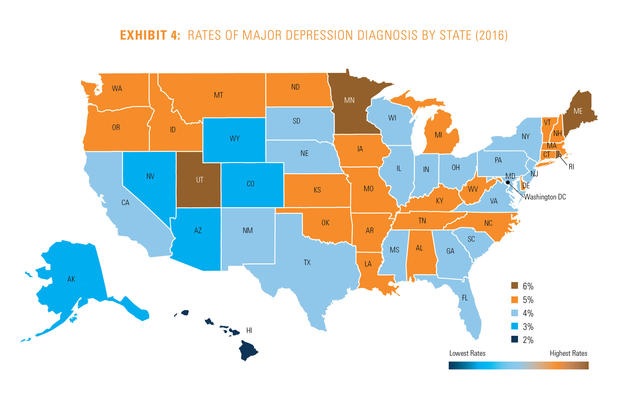
The most depressed states in the country

The most depressed states in the country

written by Christian Heinze

A new study by Blue Cross/Blue Shield shows Rhode Island scoring highest on depression; Hawaii lowest. Look at that map.

Sunlight.

Of course that passes the smell test — and for good reason.

“One Australian study that measured levels of brain chemicals flowing directly out of the brain found that people had higher serotonin levels on bright sunny days than on cloudy ones.”

Now the super interesting part.

“That effect remained no matter how cold or hot the weather was.”

So in other words, sun is the key; not warmth.

May 14, 2018
0 Facebook Twitter Google + Pinterest

Latest Mental Health News and Tips

written by Christian Heinze

via GIPHY

DEPRESSION:

A new study in JAMA Psychiatry finds strength training (resistance exercise) associated with a significant reduction in depressive symptoms.

Time Mag:

“Research suggests that by increasing blood flow to the brain, exercise can change the structure and function of the brain, create new brain cells and trigger the release of mood-enhancing chemicals like endorphins.”

By the way — personal note. The time to do this is when you’re feeling 0-6 on the depressive scale. Once you’re a 7 or above, lifting the toilet paper roll is the most resistance training you can do. So, as with other tips, being proactive is vital. Once you’re in despair, it can feel impossible to say “Ah! Weights today! Gonna feel better! Let’s do this!”

ANXIETY:

A. 40% of Americans feel more anxious today than they did a year ago. They report feeling more anxious about health, finances, safety, politics, and relationships.

Health and Safety were the Big Two, with 68% of Americans saying they felt extremely or somewhat anxious about both health and safety.

B. Fascinating article: Here are 15 signs that you’re an introvert with “High-Functioning Anxiety.”  Included: you constantly feel the need to do something, you’re outwardly successful, you’re a perfectionist, you’re afraid of disappointing others. Psych Today points out the anxiety-based foundation for the 15 signs.

C. In Inc Mag., Author Sarah Wilson says Anxiety is an incredibly common trait among entrepreneurs.

“An obsession with the future, which sufferers fear, also predisposes the anxious for startup life. Entrepreneurs ‘are constantly over-attending to things that might happen’,” Wilson says. “They see what is ahead’.”

Wilson then offers entrepreneurs tips on dealing with it.

ANOTHER CREATIVITY/MENTAL ILLNESS STUDY:

A new study in the British Journal of Psychiatry finds that those students in Sweden pursuing artistic degrees such as acting and writing were much more likely to eventually be diagnosed or hospitalized with schizophrenia, bipolar, or unipolar depression.

Specifically, students who pursued such degrees were 90% more likely to be hospitalized with schizophrenia later in life, 62% more likely to be hospitalized for bipolar, and 39% more likely to be hospitalized for depression.

IFL Science looks at this and other studies on creativity and mental health…

“So why does this connection exist?


Well, it’s still not really clear. It could be that creative people are more likely to think deeply and be emotionally unstable, making them more vulnerable to conditions like depression.


Meanwhile, bouts of productivity and high energy are linked to both creativity and bipolar disorder. Lead author James McCabe told New Scientist that the genetics behind creativity might also influence mental health.


“Creativity often involves linking ideas or concepts in ways that other people wouldn’t think of,” he told New Scientist. “But that’s similar to how delusions work – for example, seeing a connection between the color of someone’s clothes and being part of an MI5 conspiracy.”

Big note about this study. This is NOT a causation study. In other words, in no way does it suggest — at all — that the pursuit of those degrees makes you more likely to develop these conditions. Instead, if there’s a relationship, it’s likely correlation. In other words, people who are depressed or have mental illness are more likely to be drawn to certain disciplines.

VERSE of the DAY:

Luke 1:78

Because of God’s tender mercy

The morning light from heaven is about to break upon us,

to give light to those who sit in darkness

and in the shadow of death

and to guide us to the path of peace.

May 10, 2018
0 Facebook Twitter Google + Pinterest
How major depression affects fertility in some men

How major depression affects fertility in some men

written by Christian Heinze

A new study from the NIH shows that, among those couples being treated for infertility, men with major depression were 60% less likely to conceive with their partner.

The interesting thing? Women with major depression were no more or less likely to conceive.

However, women who used a type of antidepressant called non-SSRI’s (as opposed to the popular SSRI’s) were 3.5 times more likely to have a first trimester pregnancy loss.

The key thing to note is that this study looks at couples who are specifically being treated for infertility.

However, elsewhere, studies have shown that stress can affect male fertility, even in those not being treated for infertility.

Men who experienced two or more stressful life events in the past year had a lower percentage of sperm motility and a lower percentage of sperm of normal morphology, compared with men who did not experience any stressful life events.

Guys, it’s important for you to get help with stress.

So many men reel at the idea, because of cultural perceptions that men are supposed to be beacons of strength.

Well, yes, be strong and admit you’re weak, and get help.

The fact of the matter is that men have lower rates of anxiety and depression mainly because they’re much less likely to seek help for it than women. Thus, it’s likely underrreported. And that’s probably not because of a lower rate. 28% of men say they refuse to seek help for their anxiety, while only 19% of women say the same.

But that pride is dangerous.

“Men may be more likely to suffer in silence or try to self-medicate with alcohol or drugs,” says Dean F. MacKinnon, MD, an associate professor of psychiatry and behavioral sciences at the Johns Hopkins School of Medicine in Baltimore.


Men may see their symptoms as a sign of weakness, he explains, likening the situation to the idea that men don’t like asking for directions.

May 8, 2018
0 Facebook Twitter Google + Pinterest
Important stats on mental illness in the church

Important stats on mental illness in the church

written by Christian Heinze

There isn’t a ton of empirical data on mental illness and the Protestant church, but there are two important studies you should know about as a starting point. There is both encouraging and discouraging news in both.

One of the most discouraging results is that 76% of pastors and 74% of family members believe a Christian with mental illness can “thrive spiritually, even if their condition is not stable.”

I have no idea how someone who’s drenched in depression, anxiety, or even more significantly, a psychotic disorder, can “thrive spiritually.”

Yes, they can (except for in the case of a severe psychosis) obey Christ, but is rote obedience “thriving spiritually?”

That result says three things.

One, churches still aren’t getting the link between the physical disorder and spiritual walk.

Two, there’s still widespread ignorance about how mental illness affects the body.

Three, the age-old template of shaming is still in place. If someone can “thrive spiritually,” even while their mental condition is unstable, then of course the church won’t show much compassion to the mentally ill.

In this poll result, I suspect there might be a “with God, all things are possible” dynamic at work, where Christians are loathe to say that anything can prevent anyone from thriving spiritually. Yes, with God, all things are possible, but that does not mean all things are probable.

And it is very probable that an unstable mental illness that keeps the Christian from thriving in every other aspect of their life will keep them from thriving in their spiritual walk.

Perhaps this is why 18% say they’ve left a church because of the congregation’s response to their mental health.

One more thing — if you notice I italicized unstable. I don’t like that word, because it implies the individual is a few bad days away from doing something horrible. A better word for that is untreated.

So…yes, it’s completely possible for a Christian with a treated mental illness to thrive spiritually. The church and world is full of people who thrive despite mental disorders. However, it becomes much more difficult for anyone to thrive — in any capacity — with a disorder that is untreated.

Each of the statistics below is probably worthy of its own post, but here’s a laundry list.

These are highlights from Amy Simpson’s extensive survey on mental illness, published in her book on mental illness in the church.

-Only 12.5% of church leaders say mental illness is discussed openly and in a healthy way in their church.

-37% of leaders say someone in church has suffered from a psychotic disorder.

-38.7% of church leaders indicated they had suffered from a mood disorder such as depression or bipolar disorder. These say they feel more equipped to help congregants who are going through the same thing.

-23% of church leaders say they’ve suffered from an anxiety disorder.

-9% of church leaders say they’ve suffered from impulse control and addiction disorders.

-77% of church leaders are approached more than 2x/year for help with mental illness.

-37..9% of church leaders have never reached out to someone in their congregation with mental illness, despite being aware of it.

-30.5% of survey respondents said “mental illness is a reflection of a spiritual problem that must be treated spiritually.”

-29.4% of survey respondents said mental illness is a “behavioral problem caused by a person’s bad choices.

-19.7% said it’s “indicative of demon possession/demonic influence.”

-53.2% of survey respondents say they feel “somewhat equipped” to minister to people with mental illness, 16.1% feel “not equipped at all.”

Another big study comes from LifeWay Research study from 2014 (see pdf here).

-49% of senior Protestant pastors say they “rarely” or ‘never” speak about mental illness in their sermons. 16% say they do once per year. However 60% of those with mental illness in the church want the church to talk openly about it, and 65% of their families do, as well.

-Most pastors (76%) and family members (74%) think Christians with mental illness can “thrive spiritually, even if their condition is not stable.” Only 24% say they don’t know or disagree. Unbelievable.

-79% of those with mental illness had received therapy, and said it was effective.

-This survey has more hopeful results for medication than we’ve seen in the past — 87% of pastors and 54% of those with mental illness say medications should be used, when appropriate.

-18% of mentally ill people have broken ties with a church due to the response from the church; 53% say their church has been supportive.

-Only 56% of pastors “strongly agree” that “local churches have a responsibility to provide resources and support to individuals with mental illness and their families.”


May 7, 2018
0 Facebook Twitter Google + Pinterest
Spurgeon’s greatest hits on depression, anxiety, and panic

Spurgeon’s greatest hits on depression, anxiety, and panic

written by Christian Heinze

The great 19th century Baptist preacher Charles Spurgeon is a tough case for the “mental illness is spiritual” camp.

Many in the “mental illness is spiritual” camp are suspicious of contemporary preachers and theologians. But Spurgeon is rightly considered a giant of the faith by this group.

His mental illness presents a dilemma. If you say depression, anxiety and panic are either sins or reflective of a spiritual problem, the greatest preacher in evangelicalism’s history shouldn’t have been near a pulpit.

Because he was often overwhelmed with depression, anxiety and panic.

So did Spurgeon’s anxiety reflect insufficient faith in the promises of Christ, did his fear betray a lack of trust in God, and did his depression mean a Spirit of God that “always produces joy” was missing from his soul?

Further, are critics prepared to argue that Spurgeon could have just spent more time in prayer, studying Scripture, and at church to fight off his mental illness? Because that’s what the “mental illness is spiritual” camp tells the rest of us Christians.

Would they tell that to Spurgeon?

I’d like to highlight a few of Spurgeon’s quotes on these issues.

All are taken from Zack Eswine’s stellar “Spurgeon’s Sorrows” book, which is a deep dive into his sermons and writings, as well as Michael Reeve’s discussion of Spurgeon’s depression.


DEPRESSION AND ANXIETY AS MEDICAL PROBLEMS; NOT SINS

Spurgeon, in a sermon called “The Fear of Death”, and another called “Night and Jesus Not There.”

“There are certain forms of disease which so affect the brain and whole nervous system that depression is a melancholy symptom of the disease.”

And…

“I would not blame all those who are much given to fear, for in some it is rather their disease than their sin, and more their misfortune than their fault.”

It blows me away that the greatest evangelical preacher of the 19th century calls fear a disease and not a sin, that it is “misfortune” more than “fault.” I’m not even sure how often you’d hear that in modern evangelical churches.


THE SUDDEN, INEXPLICABLE ONSET OF MENTAL ILLNESS

From “The Saddest Cry of the Cross.”

“Quite involuntarily, unhappiness of mind, depression of spirit, and sorrow of heart will come upon you. You may be without any real reason for grief, and yet may become among the most unhappy of men.”

And “Night and Jesus not there.”

“There is a kind of mental darkness, in which you are disturbed, perplexed, worried, troubled – not, perhaps, about anything tangible.”

Note that he’s not talking about a causal or triggering event. Depression, anxiety, panic often just hit you – for no discernible reason. Interestingly enough, one of the distinguishing characteristics of a panic disorder is when you can’t find an easily identifiable trigger for the panic attack.


THE FOLLY OF JUDGING THOSE WITH MENTAL HEALTH PROBLEMS

Spurgeon, in “Man unknown to Man.”

“Especially judge not the sons and daughters of sorrow. Allow no ungenerous suspicions of the afflicted, the poor, and the despondent.

Do not hastily say they ought to be more brave, and exhibit a greater faith. Ask not ‘why are they so nervous and so absurdly fearful?’ No… I beseech you, remember that you understand not your fellow man.”

And from “The Saddest Cry from the Cross.”

“Strong-minded people are very apt to be hard upon nervous folk and to speak harshly to people who are very depressed in spirit, saying ‘really, you ought to rouse yourself out of that state’.”

Pride is a great sin, and spiritual pride is the greatest. Remember the Pharisee who prayed in Luke 18:11, “God, I thank you that I am not like other men, extortioners, unjust, adulterers, or even like this tax collector”.

Jesus didn’t say he was lying, but he also didn’t praise him for righteousness. He instead condemned him for arrogance. His pride wiped away everything else.

When you begin to understand the biological basis for mental illness, you have no room for spiritual pride.

Good health is a gift, faith is a gift, joy is a gift, good mental health is a gift, confidence in God’s promises is a gift. “Every good and perfect gift is from above.” (James 1:17). Who can brag about getting gifts?


SPURGEON’S DEPRESSION AND SUICIDAL THOUGHTS

Spurgeon, in “Israel’s God and God’s Israel.”

“I suppose that some brethren neither have much elevation or depression. I could almost wish to share their peaceful life. For I am much tossed up and down, and although my joy is greater than the most of men, my depression of spirit is such as few can have an idea of.”

And nearly suicidal.

“I could say with Job, ‘My soul chooseth strangling rather than life’ [Job 7:15]. I could readily enough have laid violent hands upon myself, to escape from my misery of spirit.”

And surprised that more aren’t in “Chastisement.”

“I wonder every day that there are not more suicides, considering the troubles of this life.”

Of course, as all Christians should, Spurgeon turned to Christ during his miseries, and sometimes he felt relief, sometimes he did not.

Here is one of his prayers from his autobiography.

“Thou art my Father, and I am Thy child, and thou as a father, art tender and full of mercy. I could not bear to see my child suffer as Thou makest me suffer; and if I saw him tormented as I am now, I would do what I could to help him, and put my arms under him to sustain him. Wilt thou hide thy face from me, my father? Wilt thou still lay on me thy heavy hand, and not give me a smile from thy countenance?”

So to finish — are we prepared to say that Spurgeon didn’t pray, study the Bible, or seek God enough? Are we prepared to say that the Lord often “withheld joy because Spurgeon wasn’t following Christ?” Because if we tell that to Christians struggling today, you’d have to tell that to Spurgeon, as well.

May 7, 2018
6 Facebook Twitter Google + Pinterest

Anxious? Look at the right gif

written by Christian Heinze

Evidently, looking at certain gifs can promote healthy breathing patterns, and therefore relieve some acute anxiety and panic symptoms.

Helpful if you’re at a computer, not so much if you’re driving.

Here’s one such gif. Inhale while the thing gets bigger, exhale as it gets smaller.

http://livingshitpost.tumblr.com/post/123524804649/just-in-case-anyone-needs-it

May 7, 2018
0 Facebook Twitter Google + Pinterest
The neuroanatomy and neurochemistry of depression

The neuroanatomy and neurochemistry of depression

written by Christian Heinze

In his book Grace for the Afflicted, neuroscientist Dr. Matthew Stanford discusses the major DSM-5 diagnoses, and gives a brief overview of the factors involved in their development and manifestation — including the neuroanatomy and neurochmestry of each disorder.

For example, here’s a bit of the neuroanatomy associated with depressive disorders.

“Neuroimaging studies have identified several brain structures that are dysfunctional in individuals diagnosed with depressive disorders.


Two of these structures, the amygdala and the subgenual anterior cortex (subgenual ACC), are part of what is called the limbic system. The amygdala is involved in emotionally mediated attention, in assigning emotional significance to stimuli…..the subgenual ACC appears to mediate the subjective experience of emotion.


In depressed individuals these two structures have been found to be overactivated.”

And so on.

Then he talks about the neurochemistry:

“Dysregulation in two neurotransmitters systems, norepinephrine (NE) and serotonin (5-HT), appear to be involved in the depressive disorders.


Studies have consistently found decreased levels of 5-HT and NE in depressive individuals …. abnormal regulation of this network [limbic-cortical network] results in the symptoms of the depressive disorder, heightened levels of anxiety and irritability, an inability to experience pleasure, excessive worry, and a lack of emotional control.”

Of course he then goes into much further detail.

The book takes a brief scientific look at bipolar disorders, psychotic disorders, depressive disorders, anxiety disorders, trauma and stressor-related disorders, personality disorders, dementia, cerebrovascular accidents, and traumatic brain injury.

And yes, there are verifiable scientific manifestations and explanations for all of these.

The Christian church has needed a book like this for a long time.

May 7, 2018
0 Facebook Twitter Google + Pinterest
Study: Sleeping in lighter rooms can raise your risk of depression by 65%

Study: Sleeping in lighter rooms can raise your risk of depression by 65%

written by Christian Heinze

A new study in the American Journal of Epidemiology finds that sleeping in a bedroom with more than 5 lux of light raises your risk of depression by 65%.

What’s the mechanism?

“Previous studies have suggested the possibility that LAN [light-at-night] induces sleep disturbances, impaired melatonin secretion and misalignments between sleep/wake behavior … and depression is frequently accompanied by these conditions,” the study said.

A “lux” of light is the amount that shines from a candle if you’re sitting 3.3 feet away from the candle.

The offending 5 luxes of light = a street lamp shining into your room at night.

May 7, 2018
0 Facebook Twitter Google + Pinterest
Load More Posts

Social Media

Twitter

Get in touch with me

Contact here. 

The Weary Christian mission:

First off:


In the United States, find a psychiatrist here.

In the United States, find a therapist here.

If you’re in the United States and having thoughts of harming yourself or others, please call the National Suicide Lifeline at 1-800-273-8255.

If you’re in the UK, get urgent help here.

Canada, here.

Australia, here.

New Zealand, here.

South Africa, here.

France, here.

Germany, here.

Portugal, here.

Mexico, here.

India, here.

The Philippines, here.

Singapore, here.

South Korea, here.


The Weary Christian goal…


a) reduce the stigma surrounding depression, anxiety, OCD, and other conditions in the Christian community.


b) have uncomfortable but honest conversations.


c) Reduce the stigma surrounding antidepressants, antipsychotics, and other meds God has given us as gifts.


And…


d) Sometimes (tons of times), we all feel really, really depressed in our journey. Hopefully, this site makes you feel less alone.

Categories


@2017 - PenciDesign. All Right Reserved. Designed and Developed by PenciDesign