
The Weary Christian
  • Depression
    • Depression

      Latest Medical Studies on Depression

      Depression

      James Bryan Smith: Unmet expectations and fear

      Depression

      STUDY: Criticizing older adults make them more vulnerable…

      Depression

      STUDY: Awe can reduce depressive symptoms

      Depression

      STUDY: How music-mindfulness can help depression, anxiety

  • Anxiety
    • Anxiety

      Calling out the brain on catastrophizing

      Anxiety

      James Bryan Smith: Unmet expectations and fear

      Anxiety

      STUDY: Awe can reduce depressive symptoms

      Anxiety

      STUDY: How music-mindfulness can help depression, anxiety

      Anxiety

      STUDY: Chronic pain associated with higher rates of…

  • Book quotes/Video
    • Book quotes/Video

      John Mark Comer: “Wherever Jesus went, the kingdom…

      Book quotes/Video

      Ann Voskamp: “Jesus saves you for Himself”

      Book quotes/Video

      Philippe: “Refusing to suffer means refusing to live”

      Book quotes/Video

      “In darkest night, you were there like no…

      Book quotes/Video

      Thanksgiving for his brokenness

  • Health News
    • Health News

      Latest Medical Studies on Depression

      Health News

      Calling out the brain on catastrophizing

      Health News

      STUDY: Mental health conditions share deep genetic patterns

      Health News

      STUDY: Four Supplements that MIGHT help depression

      Health News

      STUDY: Gut changes raise risk of eating disorders…

  • Interviews
    • Interviews

      INTERVIEW: Dr. Terry Powell’s gripping account of depression

      Interviews

      INTERVIEW: Therapist Michael Schiferl explains religious scrupulosity and…

      Interviews

      INTERVIEW: Rocker Matt Sassano shares battles, urges transparency…

      Interviews

      INTERVIEW: Dr. Brian Briscoe tells Christians that antidepressants…

      Interviews

      INTERVIEW: Pastor Scott Sauls on anxiety, depression, and…

  • Devotionals
    • Devotionals

      Think you’re a “failure?” Jesus sees you unlike…

      Devotionals

      “Grace has got to be drunk straight”

      Devotionals

      Defeated by God

      Devotionals

      Am I a faithless Christian?

      Devotionals

      “I killed Jesus of Nazareth”

  • About
  • Depression
    • Depression

      Latest Medical Studies on Depression

      Depression

      James Bryan Smith: Unmet expectations and fear

      Depression

      STUDY: Criticizing older adults make them more vulnerable…

      Depression

      STUDY: Awe can reduce depressive symptoms

      Depression

      STUDY: How music-mindfulness can help depression, anxiety

  • Anxiety
    • Anxiety

      Calling out the brain on catastrophizing

      Anxiety

      James Bryan Smith: Unmet expectations and fear

      Anxiety

      STUDY: Awe can reduce depressive symptoms

      Anxiety

      STUDY: How music-mindfulness can help depression, anxiety

      Anxiety

      STUDY: Chronic pain associated with higher rates of…

  • Book quotes/Video
    • Book quotes/Video

      John Mark Comer: “Wherever Jesus went, the kingdom…

      Book quotes/Video

      Ann Voskamp: “Jesus saves you for Himself”

      Book quotes/Video

      Philippe: “Refusing to suffer means refusing to live”

      Book quotes/Video

      “In darkest night, you were there like no…

      Book quotes/Video

      Thanksgiving for his brokenness

  • Health News
    • Health News

      Latest Medical Studies on Depression

      Health News

      Calling out the brain on catastrophizing

      Health News

      STUDY: Mental health conditions share deep genetic patterns

      Health News

      STUDY: Four Supplements that MIGHT help depression

      Health News

      STUDY: Gut changes raise risk of eating disorders…

  • Interviews
    • Interviews

      INTERVIEW: Dr. Terry Powell’s gripping account of depression

      Interviews

      INTERVIEW: Therapist Michael Schiferl explains religious scrupulosity and…

      Interviews

      INTERVIEW: Rocker Matt Sassano shares battles, urges transparency…

      Interviews

      INTERVIEW: Dr. Brian Briscoe tells Christians that antidepressants…

      Interviews

      INTERVIEW: Pastor Scott Sauls on anxiety, depression, and…

  • Devotionals
    • Devotionals

      Think you’re a “failure?” Jesus sees you unlike…

      Devotionals

      “Grace has got to be drunk straight”

      Devotionals

      Defeated by God

      Devotionals

      Am I a faithless Christian?

      Devotionals

      “I killed Jesus of Nazareth”

  • About

The Weary Christian

THE WEARY CHRISTIAN

LIVING WITH FAITH AND DEPRESSION

  • Depression
    • Depression

      Latest Medical Studies on Depression

      Depression

      James Bryan Smith: Unmet expectations and fear

      Depression

      STUDY: Criticizing older adults make them more vulnerable…

      Depression

      STUDY: Awe can reduce depressive symptoms

      Depression

      STUDY: How music-mindfulness can help depression, anxiety

  • Anxiety
    • Anxiety

      Calling out the brain on catastrophizing

      Anxiety

      James Bryan Smith: Unmet expectations and fear

      Anxiety

      STUDY: Awe can reduce depressive symptoms

      Anxiety

      STUDY: How music-mindfulness can help depression, anxiety

      Anxiety

      STUDY: Chronic pain associated with higher rates of…

  • Book quotes/Video
    • Book quotes/Video

      John Mark Comer: “Wherever Jesus went, the kingdom…

      Book quotes/Video

      Ann Voskamp: “Jesus saves you for Himself”

      Book quotes/Video

      Philippe: “Refusing to suffer means refusing to live”

      Book quotes/Video

      “In darkest night, you were there like no…

      Book quotes/Video

      Thanksgiving for his brokenness

  • Health News
    • Health News

      Latest Medical Studies on Depression

      Health News

      Calling out the brain on catastrophizing

      Health News

      STUDY: Mental health conditions share deep genetic patterns

      Health News

      STUDY: Four Supplements that MIGHT help depression

      Health News

      STUDY: Gut changes raise risk of eating disorders…

  • Interviews
    • Interviews

      INTERVIEW: Dr. Terry Powell’s gripping account of depression

      Interviews

      INTERVIEW: Therapist Michael Schiferl explains religious scrupulosity and…

      Interviews

      INTERVIEW: Rocker Matt Sassano shares battles, urges transparency…

      Interviews

      INTERVIEW: Dr. Brian Briscoe tells Christians that antidepressants…

      Interviews

      INTERVIEW: Pastor Scott Sauls on anxiety, depression, and…

  • Devotionals
    • Devotionals

      Think you’re a “failure?” Jesus sees you unlike…

      Devotionals

      “Grace has got to be drunk straight”

      Devotionals

      Defeated by God

      Devotionals

      Am I a faithless Christian?

      Devotionals

      “I killed Jesus of Nazareth”

  • About
DepressionHealth News

Latest Medical Studies on Depression

STUDY: Mental health conditions share deep genetic patterns

James Bryan Smith: Unmet expectations and fear

STUDY: Four Supplements that MIGHT help depression

STUDY: Criticizing older adults make them more vulnerable to developing depression

Daily Blog

Study: Anxious people are better at escaping slow-developing threats

Study: Anxious people are better at escaping slow-developing threats

written by Christian Heinze

A new study shows that anxious people are much better at perceiving and reacting to a slow-developing threat (not surprising), but no better at reacting to a quickly-developing threat than their happy-go-lucky neighbor.

Specifically, participants with higher trait anxiety escaped much quicker from the menacing threat of a slowly encroaching virtual predator than did those with lower anxiety.

However, when the virtual predator pounced immediately, there was no difference between the more and less anxious participants.

To put it into day-to-day terms:

Let’s say you’re an anxious person, and you see a mole on your arm that’s kind of sketchy. You’ll probably get it checked out before it turns into a melanoma. See, slow-developing threat.

Your optimistic neighbor, Bob, on the other hand, might wait until it’s bleeding, throbbing, and 12 inches in diameter.

He wasn’t good at reacting to the slow-developing threat.

Now let’s say both you and Bob’s hair is on fire. You’ll be equally good at responding to that threat, because it develops quickly.

So why are some people quicker at responding to slow-developing threats than others?

Well, it all has to do with the part of the brain that’s triggered by slow-developing threats vs. immediate threats.

Slow-developing threats trigger heightened activity in our hippocampus, which is the area of the brain responsible for planning and assessing risk.

Meanwhile, immediate threats trigger reactions in the fear circuit, which is in the central part of our brain.

There’s actually a lot of spiritual application here for a different time and day, but at the top of the list is that we should be very careful about judging more anxious people.

The planning-based portion of their brain is activated much more quickly, and that’s not a sinful thing.

In fact, it could be that those with higher trait anxiety will save the lives of their optimistic friends who choose to wait to act until they can actually see the flames on the ship.

Painting: Approaching Thunderstorm, Martin Johnson Heade.

July 22, 2019
0 Facebook Twitter Google + Pinterest
Spurgeon: Allured by God’s love in the wilderness

Spurgeon: Allured by God’s love in the wilderness

written by Christian Heinze

A good reading from Charles Spurgeon’s Chequebook of the Bank of Faith devotional, based on Hosea 2:14:

“I will allure her, and bring her into the wilderness, and speak comfortably unto her.”


“The goodness of God sees us allured by sin, and it resolves to try upon us the more powerful allurements of love.

Do we not remember when the Lover of our souls first cast a spell upon us and charmed us away from the fascinations of the world?

He will do this again and again whenever he sees us likely to be ensnared by evil.

He promises to draw us apart, for there he can best deal with us, and this separated place is not to be a Paradise, but a wilderness, since in such a place there will be nothing to take off our attention from our God.

In the deserts of affliction, the presence of the Lord becomes everything to us, and we prize his company beyond any value which we set upon it when we sat under our own vine and fig tree in the society of our fellows.

Solitude and affliction bring more to themselves and to their heavenly Father than any other means.

When thus allured and secluded the Lord has choice things to say to us for our comfort.

He ‘speaks to our heart,’ as the original has it. Oh that at this time we may have this promise explained in our experience!

Allured by love, separated by rial, and comforted by the Spirit of truth, may we know the Lord and sing for joy!


I recently turned 40 years old, and read a passage a few months ago that particularly struck me.

During Stephen’s famous sermon in Acts, he quotes Amos 5:25-26, where God says to his people, “Was it to me you were bringing sacrifices and offerings during the 40 years in the wilderness, Israel? No, you served your pagan gods.”

Where have I been the past 40 years? Much of it in the wilderness, and much of that time serving my pagan gods, whatever they may be.

We often talk about how we complain in our wanderings in the desert, like the children of Israel in theirs, but we rarely ask where we took our sacrifices. Maybe we haven’t complained, but who have we served?

I don’t want to serve my pagan gods, and may my next 40 years — may yours — find us bringing God sacrifices. Not just because he deserves them, but because that’s the only way life can feel like life.

After all, as God also says in Hosea: “Oh Israel, stay away from idols!”

But why? Because God is simply jealous? No.

“I am the one who answers your prayers and cares for you. I am like a tree that is always green; all your fruit comes from me.”

(Photo: Sinai Desert, wikipedia).

July 19, 2019
0 Facebook Twitter Google + Pinterest
Huge study: Anorexia has a genetic link

Huge study: Anorexia has a genetic link

written by Christian Heinze

For the first time, researchers have discovered eight genes directly related to anorexia nervosa.

It’s a groundbreaking study because, up until now, scientists couldn’t identify any.

Now for the particularly surprising part.

It’s often assumed that anorexia originates from behavioral and psychological factors, but the scientists found that some of those genes were directly related to an entirely different factor.

Professor Nicholas Martin tells The Age, “The other part we hadn’t expected to see is strong links to metabolism, both in terms of body build, body weight and genes involved in diabetes.”

Importantly, the genes linking anorexia with metabolism were not the common variants associated with body-mass index, meaning something more complex was going on at a genetic level.

Co-study leader Gerome Breen tells Newser: “Anorexia has the expected correlations with anxiety, depression and OCD, but it also has this set of apparently healthy metabolic correlations that we don’t see in any other psychiatric disorder.”

In other words, researchers says we should now identify it as a metabo-psychiatric disorder.

This is probably the tip of the iceberg.

For example, Professor Martin notes that we’ve found almost 200 genes directly related to schizophrenia, about 30 to bipolar, and around 100 to depression.

Over time, we’ll probably find more and more related to anorexia nervosa, which is, by far, the deadliest psychiatric disorder (for example, the mortality rate is 4x higher than major depression and 2x higher than schizophrenia).

This is hugely important for treatment.

Breen tells The Guardian: “What our study means is we can no longer treat anorexia, and perhaps other eating disorders, as purely psychiatric or psychological.”

Breen said there was now a need for scientists to study the metabolism of people with anorexia and other eating disorders to see whether it was possible to develop metabolism-based therapies, or spot those at risk of relapse, a common problem in anorexia.

It’s also profoundly important for helping those who suffer with anorexia to better understand why they’re saddled with this disease.

It will also, hopefully, prompt loved ones to treat those suffering with more compassion and understanding.

Painting: L’attesa, Felice Casorati. (h/t: Casey Winter).

July 19, 2019
0 Facebook Twitter Google + Pinterest

Mental Health Links

written by Christian Heinze

a. Study: Are the viral agents of MS, ALS, and schizophrenia buried in our genes?

b. Diabetics who use antidepressants have lowered mortality risk.

c. People with comorbid OCD and bipolar have a higher suicide risk.

d. Study: Why Matcha tea helps with anxiety.

e. 10 Health Anxiety Myths Debunked.

f. Artificial Intelligence can detect depression in your voice.

g. Ed Sheeran on his battle with anxiety: “I closed off from reality.”

h. Olivia Culpo talks about her depression: I pretended everything was great.

i. Cheryl Cole on her depression: I’d smile, “but inside I was dying.”

j. You can now get medical marijuana for anxiety in Pennsylvania.

“It gives your Father great happiness to give you the Kingdom.” Luke 12:32

July 16, 2019
0 Facebook Twitter Google + Pinterest
Piper: We’re not “partners” with God

Piper: We’re not “partners” with God

written by Christian Heinze

John Piper, in Desiring God, with a wonderful message for those of us who are tempted to work for our salvation.


“Religious ‘flesh’ always wants to work for God (rather than humbling itself to realize that God must work for it in free grace).

…. Any servant who tries to get off the divine dole and strike up a manly partnership with his heavenly Master is in revolt against the Creator.”

July 15, 2019
0 Facebook Twitter Google + Pinterest

Do Trigger Warnings work?

written by Christian Heinze

Slate’s Shannon Palus has a great review and write-up of academic literature on the controversial topic of trigger warnings.

In a well-meaning effort, more and more universities are attaching warnings to material that could stir up memories of past trauma for readers or viewers.

For example, if there’s a novel with rape, the university will affix a trigger warning for rape survivors lest they stir up awful memories.

Religious conservatives often really hate this kind of stuff (“snowflake generation,” they accuse), which is perplexing. Universities etc don’t do this to harm students. Their purpose is kindness and consideration (Which is far more noble than the hateful rhetoric from the evangelical-beloved-president that is designed to stir up division and hatred).

But the fact of the matter is that studies show trigger warnings either don’t work or actually might be harmful.

There are some theories trying to explain the growing empirical evidence.

First, “cognitive avoidance” doesn’t work. In other words, people have to process and address traumatic memories. Stuffing it away, refusing to engage doesn’t make it somehow better. The storm just grows.

Second, a trigger warning can actually be… a trigger. If a warning says, “trauma ahead,” that puts readers in an emotionally fragile state of mind.

Third, trigger warnings might reinforce the idea that a reader’s trauma is more central to their identity than anything else.

All in all, trigger warnings don’t seem to help people process whatever they read, they may amplify the effect of the traumatic material, and they may contribute to harmful self-identity.

Either that or — they do nothing at all.

That’s what the studies show.

So how do we help? Shannon Palus suggests:

That’s not to say that people who have experienced trauma should be left on their own to have that panicked response and just get over it.

“Rather than issuing trigger warnings, universities can best serve students by facilitating access to effective and proven treatments for P.T.S.D. and other mental health problems,” Richard McNally, a Harvard psychologist and co-author on the paper with Jones, wrote in the New York Times in 2016. 

July 15, 2019
0 Facebook Twitter Google + Pinterest
BeliefNet: Don’t say these things to a depressed Christian

BeliefNet: Don’t say these things to a depressed Christian

written by Christian Heinze

Over at BeliefNet, Megan Bailey has a great list of the things cheery Christians who were born with optimistic dispositions say to the depressed.

Her list:

  1. “Confess your sins to God.”
  2. “Others have been through it worse.”
  3. “You will get over it.”
  4. “You need this specific medication, therapy or treatment to be happy.”
  5. “God won’t give you more than you can handle.”
  6. “You should work on strengthening your faith.”

I just wanted to mention something about the fifth (which is based on a verse from 1 Corinthians 10): “God won’t give you more than you can handle.”

We’ve heard that countless times from well-intentioned ministers who are, rightly, urging people to keep going.

But that’s because we’re interpreting that verse completely wrong.

The verse is this (NKJV): “No temptation has overtaken you except such as is common to man; but God is faithful, who will not allow you to be tempted beyond what you are able, but with the temptation will also make the way of escape, that you may be able to bear it.”

Most translations use “temptation” there, but others also use “trial.” The meaning seems to change, doesn’t it?

Most Christians would argue that, yes, indeed, God has given us every means (The Spirit) to overcome any temptation, but we all know that is a completely different matter than God giving us every means to overcome a trial.

A trial, for example, might be cancer. The temptation would be to abandon God during your bout with cancer. God doesn’t promise the means for deliverance from the trial (the cancer), but he does promise the means for staying true to him during the trial (his Spirit).

Your body probably won’t be able to handle the trial, but your devotion to God can.

That’s what this verse is about.

So why is it sometimes translated “trial”? Hero translator James Strong says that the Greek word can mean both “trial” or “temptation,” and context is key.

All of I Corinthians 10 is about temptation, so the reasonable assumption is that verse 13 is also about temptation.

That’s why the ESV, NLT, ASV, and NKJV have all translated that word “temptation.”

Unfortunately, many Christians misread the verse and use it to give false hope that God will never send a trial that sends us over the edge.

Now… before I finish: one comment on #2: “Others have been through worse.”

This is also ubiquitous, but it’s ridiculous to say on a couple counts.

First, many of us respond: “Yes, they have been through worse and that makes the world all the more sad.”

It’s not like we suddenly think, “Oh, people are doing even worse than I am. Now I feel better!”

Second, as T.S. Eliot wrote of suffering in The Cocktail Party (quoted in Glorious Ruin): “All cases are unique, and very similar to others,” while Charles Spurgeon said, “We should feel more for the prisoner if we knew about the prison.”

We should never compare suffering. If you’re feeling awful, you’re feeling completely awful. In fact, depressed people often can’t find a reason, but that doesn’t mean the suffering is any less intense.

Again, going to our buddy Spurgeon: “The flesh can bear only a certain number of wounds and no more, but the soul can bleed in ten thousand ways, and die over and over again each hour.”

July 12, 2019
0 Facebook Twitter Google + Pinterest
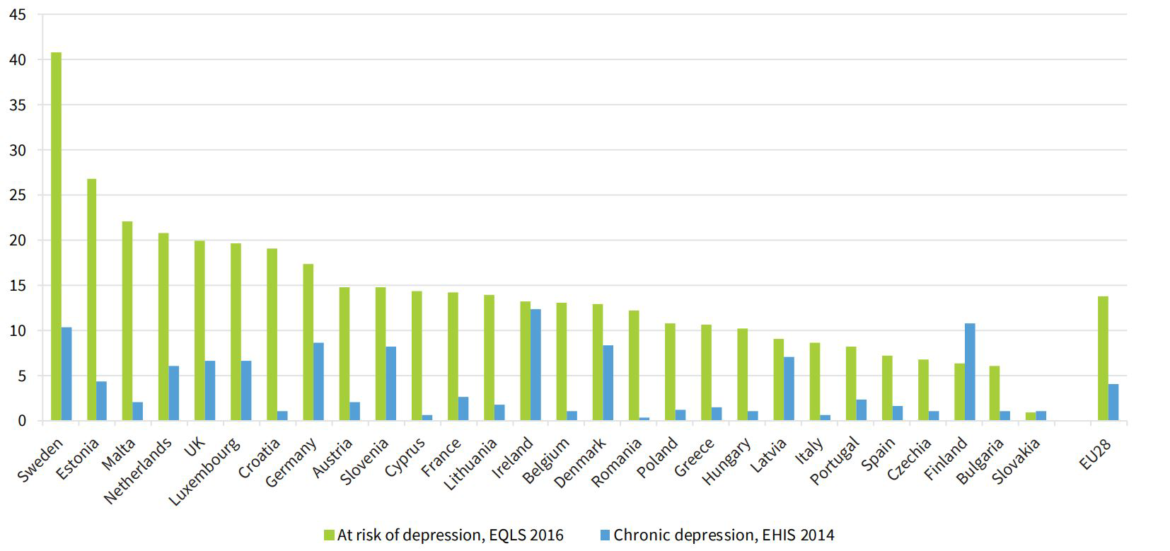
For once, Sweden tops a troubling list

For once, Sweden tops a troubling list

written by Christian Heinze

We’re used to seeing Sweden (and other Nordic countries) at the top of so many lists of best countries for XYZ. XYZ is usually something related to quality of life.

Sweden, as it turns out, is #2 on Quality of Life, #6 on Good Country List (defined as contributors to global well-being), and #7 on happiness.

That might be about to change.

A new study of EU member nations shows Swedish youth are, by far, at the highest risk for depression.

A whopping 41% of Swedes 18-24 years old are listed as risks for depression, considerably higher than runner-ups Estonia and Malta.

One possible explanation?

The report highlights widespread feelings of marginalisation among young people in Europe due to the economic crisis. Presenting in-depth case studies of support services in five Member States, it notes the significant spike in child and youth homelessness in several countries since the crisis – including in economically advanced Member States typically characterised by welfare states and higher levels of social spending.

July 11, 2019
0 Facebook Twitter Google + Pinterest
STUDY: How inflammation can affect motivation

STUDY: How inflammation can affect motivation

written by Christian Heinze

One of the classic symptoms of depression is a lack of motivation, and cheery judgmental folks often judge the depressed as “lazy” when they lie in bed and wake up only to watch Jeopardy, then go back to bed.

But if you’ve ever been severely depressed, you know how overwhelming it is to just gin up the strength to live.

And to really “live” in the Dance in the Rain/Instagram Life way?

To tweak the words of Jesus: “It is easier for a camel to pass through the eye of a needle than for a severely depressed person to dance in the rain.”

That’s why mental illness is the leading cause of disability in the United States. It’s not because people are lazy. It’s because dread, hopelessness, and misery strip us of the strength to do anything.

In A Grief Observed, C.S. Lewis writes, “No one ever told me about the laziness of grief” and “it’s easy to see why the lonely become untidy, finally, dirty and disgusting.”

Well, science is starting to understand why.

Studies are showing that the chronic low-grade inflammation that can lead to depression significantly affects our levels of dopamine.

Dopamine is what drives motivation. If you have low levels of dopamine, you probably can’t gin up much motivation.

Now a fascinating new study in Trends in Cognitive Sciences is giving us some idea of why.

Basically, chronic inflammation tells the body to fight something, and dopamine gets the short end of the stick.

Or as the study authors put it: “the immune system disrupts the dopamine system to help the brain perform this recalibration.”

That doesn’t happen to everyone, but in the depressed, it appears the immune system often doesn’t work right and affects your dopamine levels.

(Think about Elijah, retreating to the cave during his battle with a depressive episode. He seems to have lost motivation to prophet it up).

In the same way, you and I feel like retreating from our responsibilities during a bout of depression. It’s our dopamine, not some grand design to get out of things just because we want an extra hour to play Madden Mobile.

Of course, we have to fight through this, but it’s also important to give ourselves grace, and also for others to understand the scientific basis for this very real loss of motivation before they text us: “Go to the ant, you sluggard.”

Painting: Ennui, Walter Sickert.

July 9, 2019
0 Facebook Twitter Google + Pinterest

Mental Health Links

written by Christian Heinze

a. Golfer Thomas Bjorn talks about his depression: “When you’re a young man, you hide your feelings.”

b. A story about postpartum anxiety.

c. Coping with depression during retirement.

d. Study: Gender affects the correlation between depression and weight in children and adolescents.

e. Study: Anxiety in Late Life: An update on Pathomechanisms.

f. Kate Middleton’s brother talks about his “crippling” depression.

g. Fast Company: Coping with Social Anxiety.

“And this is the secret: Christ lives in you. This gives you assurance of sharing his glory.” — Colossians 1:27

June 28, 2019
0 Facebook Twitter Google + Pinterest
Load More Posts

Social Media

Twitter

Get in touch with me

Contact here. 

The Weary Christian mission:

First off:


In the United States, find a psychiatrist here.

In the United States, find a therapist here.

If you’re in the United States and having thoughts of harming yourself or others, please call the National Suicide Lifeline at 1-800-273-8255.

If you’re in the UK, get urgent help here.

Canada, here.

Australia, here.

New Zealand, here.

South Africa, here.

France, here.

Germany, here.

Portugal, here.

Mexico, here.

India, here.

The Philippines, here.

Singapore, here.

South Korea, here.


The Weary Christian goal…


a) reduce the stigma surrounding depression, anxiety, OCD, and other conditions in the Christian community.


b) have uncomfortable but honest conversations.


c) Reduce the stigma surrounding antidepressants, antipsychotics, and other meds God has given us as gifts.


And…


d) Sometimes (tons of times), we all feel really, really depressed in our journey. Hopefully, this site makes you feel less alone.

Categories


@2017 - PenciDesign. All Right Reserved. Designed and Developed by PenciDesign