
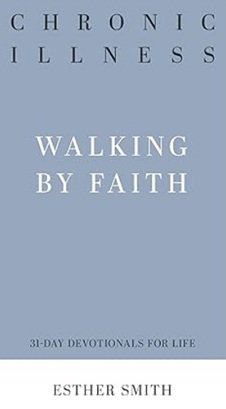
In her wonderful book, Chronic Illness: Walking by Faith, Esther Smith offers a strangely hard truth — one we often hear, theoretically, but do we really believe it?
Smith:
“God doesn’t want the things that you could be doing if you were healthy. All he wants is you.
He wants your faith, not your works. He wants your company, not grand feats. He wants to get to know you, and this is something you can do no matter what your daily life with illness looks like.
As I began to write this book, I asked myself a question. What is the number one message that people with chronic illness need to hear? What is the most important lesson that my own experience has taught me? In the end, I realized it was this: Your relationship with God is vital for your survival. People will let you down. Symptoms will come and go. Life will be painful and filled with grief. God is your only certainty.
Seek God, and you will find him (see Deut. 4:29). Draw near to God, and he will draw near to you.”
Amen. Also hard and also a relief – in much the way that so much of the Christian life is.
Think again about that quote: ““God doesn’t want the things that you could be doing if you were healthy. All he wants is you.“
Both our own personalities and culture can form an unholy alliance that whispers to the chronically ill — you don’t matter. You’re not useful. You lie there, doing very little, you are a drain on society and those around you, what’s your use if you feel of no use? If you have nothing to contribute, why are you even here?
These accusations come from us, the devil, and also the world, and sometimes unfortunately, the church. As humans we tend to celebrate the “great” Christians who led many to Christ, the ones who accomplish great things to alleviate human poverty, malnourishment, to build and grow local churches that water the local community with the fountain of life.
If you don’t realize this, just look at the opulent funerals for some of the “giants of the faith.”
Now — all those things they do are good things! They are massive answers to prayer to so many.
But humans are prone to worship, and in our admiration for those works and the ones accomplishing them, it can also crush us with a kind of “So… what have you done lately?”
Maybe it’s just me. Maybe it’s my pride. Maybe others with chronic illness don’t feel this. But as I’ve battled my growing physical inadequacies the past 3 years, I’ve had to contend with a global feeling of spiritual deficiency.
And now comes the “And can it be?” relief that Miller offers in this sentence: “”God doesn’t want the things that you could be doing if you were healthy. All he wants is you.”
And that’s true, praise God.
The world wants what we can do. God simply wants us. He has plenty of people to do the things we can’t. Besides, what if we, the chronically ill, are called to our own thing — and that own thing is to just be content with the fact that we can “do nothing” for God, except praise him, that we can do nothing for others, except pray for them?
Aren’t those nothings something?
They require faith, faith, faith to believe that we matter when American culture (particularly, the Protestant Work Ethic kind) says we don’t. They require faith, faith, faith when we see so little accomplishment to validate that faith, hear so little to spur us on, when those things – the quiet things – just seem so flat and useless.
But we are God’s children. Does our love for our kids hinge on what they do? Their works? No! All we want with them is relationship. I could care less if my kids did much around the house. I don’t want their works, I want relationship.
And here is also God: All I want is you. Your faith, your heart, your friendship.
Now I ask you — you who are struggling with any number of physical or mental diseases? Do you also struggle with mattering in a world that has only one definition of mattering?
If you’re in church world and you only matter if you can lead this group or that group, or be involved in this ministry or that ministry, and instead all you can do is barely show up or not at all.
First, all God wants is a relationship with you, and you can still create your own sanctuary to God at home where heaven meets earth, where heaven meets your home. Those personal sanctuaries, where it’s just you and God, is where relationship forms and grows.
Second, if you’re in the broader world and you can’t work because of your illness, you might hear others say, “So what do you do?” Oh, isn’t there pain to just reply: “I’m sick.” Ugh!! Aren’t we inclined to lie, to somehow gin up something better than “I’m sick.”
We want to feel we matter – to ourselves, to others, to our community. I’m not sure where my own aspiration to genuinely help others and spiritual pride and desire to work my way into God’s good graces meet and interact, but whatever the case for me, for you, we just plain old want to matter.
And sickness can make us feel like we don’t. And maybe, others make it painfully – so painfully – clear we don’t to them.
But listen, the only One Who Matters came exactly to you and and me — the sick and the struggling. And for that brief moment of his ministry, those brief three years in the world, we were the object of the tender hand of the All Powerful God who came to validate, to encourage, to forever alter how Christians are to view poverty of body, bank account, and mind.
Does it matter enough to us that we matter to God?
That’s the question I have to ask myself daily.
If we only matter to God, isn’t that enough?
If it takes our sickness to find God’s friendship, to desire it more than our own wellness, to seek and find him, then it will all be worth it in the end, and in this current moment, if it’s worth it, how wonderful a bonus is that?
So I write this to me, I write this to you.
And I remind you – that you matter to God, that you matter so much that he died for you. The thief could do nothing and did nothing on earth except steal and kill. And when he could do nothing else except beg “remember me,” that was enough.
If you struggle with depression, anxiety, or any other such disorders — for readers in the United States… please read Smith’s book.
And…
Find a psychiatrist here.
Find a therapist here.
For readers, internationally, seek help from a local resource.
For salvation, Christ and Christ alone.
