
In his book, Waking from The American Dream, Donald McCullough puts our remarkable salvation from Christ this way:
“Grace means that in the middle of our struggle the referee blows the whistle and announces the end of the game.
We are declared winners and sent to the showers. It’s over for all huffing, puffing piety to earn God’s favor; it’s finished for all sweat-soaked straining to secure self-worth; it’s the end of all competitive scrambling to get ahead in the game.
Grace means that God is on our side and thus we are victors regardless of how well we’ve played the game.”
If we doubt this, why Jesus’ death?
If we don’t agree with what McCullough says, how can Paul slam the idea of boasting about our salvation? All is mercy, all is grace, and we can do nothing to earn it. Only Christ could and only he did.
Here’s the Presbyterian minister and former Senate chaplain Lloyd Ogilvie who puts our response to redemption in the context of Peter’s denial of Christ and subsequent encounter with Jesus after the Resurrection.
“Peter had built his whole relationship on his assumed capacity to be adequate.
That’s why he took his denial of the Lord so hard. His strength, loyalty, and faithfulness were his self-generated assets of discipleship.
The fallacy in Peter’s mind was this: He believed his relationship was dependent on his consistency in producing the qualities he thought earned him the Lord’s approval.
Many of us face the same problem. We project into the Lord our own measured standard of acceptance. Our whole understanding of him is based on a quid pro quo of bartered love. He will love us if we are good, moral, and diligent.
But we have turned the tables; we try to live so that he will love us, rather than living because he has already loved us.”
We have trouble believing this, don’t we? (I really, really do). Why?
Because it makes no sense, based on the world we see around us — where our worth is tied up in how good we are, how productive we are, whose “political team” we’re on, how successful in any sphere we are. We can’t get away from the human conception of personal worth – no matter how a culture defines it or how a political party defines it or how we define it for ourselves.
But Christ’s work on the cross smashes all that by saying it’s about His worth – not our own. It’s about his accomplishment, not our own.
No other religion, no human mind could have devised a redemption like this because it runs counter to the natural order of things. And thus, it can only come from a supernatural one and supernatural love.
You are loved because you are loved, you are accepted – not based on your worth or efforts – but based on his worth.
As Brennan Manning writes in his book The Ragamuffin Gospel (which contained the quotes I referenced and is the most beautiful tome on God’s redemption you can find), God expects more failure from us than we do.
Think of that. He expects less out of us than we do. What other God? Certainly not the gods of this world or the ones of American society.
And that’s why he sent Jesus.
This salvation calls himself “The Light of the World.” What else could light up the dark heaviness of the world and its value system and our own expectations?
This is the answer to the world’s accusations and constant bickering. Not “winning” or “owning the other side.” But living in the light of his love.
When we think of what Jesus did for us, it’s impossible for us to judge another.
If he could look down and forgive us, how can we look down on another?
But if we look up and see what he did for us on the cross, well, as Brandon Lake sings, “All that I have is a hallelujah, and I know it’s not much, but I’ve got nothing else fit for a king. Except for a heart singing hallelujah.”
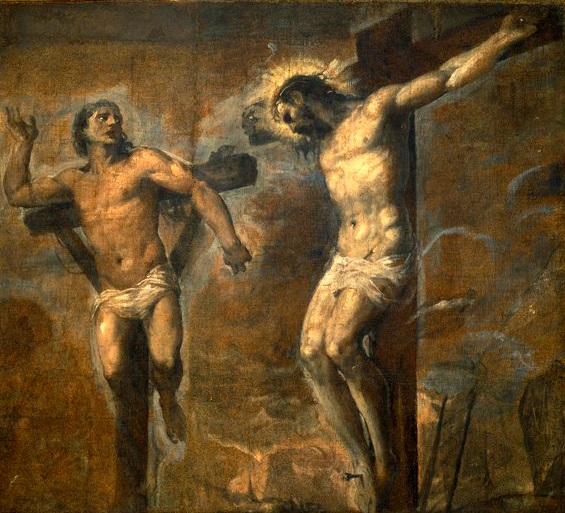
[Painting: Christ and the Good Thief, Titian]
